When it comes to a child’s education, every parent wishes to give them the best education. Education curriculum plays a major role in imparting the best education to every child. That is why parents are quite careful with the selection of curriculum. They understand that the right curriculum will help shape their child’s academic foundation.
It will impact children’s thinking ability, confidence, and overall approach to learning. Unlike old times, today, parents look beyond textbooks and notes. They are in lookout for a curriculum that focuses on:
- Offering clarity in concepts
- Promoting practical application
- Critical thinking
- Holistic development
Such a curriculum prepares students for school examinations and beyond. As a leading CBSE-affiliated school in Noida, we at The Khaitan School follow a structured academic framework that fulfils both standard and modern learning needs. Here we are answering a few common queries of parents related to curriculum design, teaching methods, assessment patterns, use of technology in schools, and how curriculum helps in holistic development.
What Factors Should Parents Consider When Choosing a Curriculum?
When it comes to choosing a curriculum, parents must do a careful evaluation. They must check if the curriculum matches the child’s learning style and future aspirations, as well as emotional and physical wellness.
Some of the factors to evaluate are:
- Look for a curriculum that utilizes concepts based teaching rather than rote memorization.
- Check the teaching methodology adopted by teachers and schools.
- Also evaluate their assessment pattern and pressure in regards to exams.
- Do not forget to check the student–teacher ratio in every classroom.
- Check if they have integrated the latest technology for modern learning.
- Look for opportunities for co-curricular activities and other skill development.
- Ensure that their teaching aligns with higher education and competitive exams.
A well-structured curriculum helps build confidence and adaptability. At The Khaitan School, we offer a similar curriculum that balances academic consistency with skill development. We also focus on student well-being, ensuring steady progress without putting unnecessary pressure on them.
What Are the CBSE Curriculum Details Followed at The Khaitan School?
At The Khaitan School, we follow the curriculum prescribed by the Central Board of Secondary Education (CBSE), one of India’s most recognized national boards for education. The CBSE framework is valued and highly appreciated for its structured academic progression. It maintains consistency in the quality of education across the nation through its balanced design and learning methods. It encourages students to work beyond memorization and focus on deeper understanding by offering clarity of concepts. One of the best parts is that CBSE Board focuses on practical application of concepts across multiple disciplines. The curriculum particularly highlights:
- Conceptual clarity in core subjects
- Application-based learning
- Critical and analytical thinking
It is designed to prepare students for higher education and competitive examinations, the CBSE curriculum ensures academic continuity from primary to senior secondary levels. At The Khaitan School, we implement this framework thoughtfully to support steady academic growth and confidence in learners.
What Teaching Methodology Is Used at The Khaitan School?
The teaching methodology at The Khaitan School is student-centric, progressive, and aligned with contemporary educational practices. Classrooms are designed to encourage participation, curiosity, and dialogue rather than one-way instruction. Teachers act as facilitators, guiding students to explore concepts, ask questions, and connect learning to real-life contexts. The school incorporates approaches such as:
- Experiential learning
- Inquiry-based instruction
- Project-based learning
- Blended classroom strategies
Some of the benefits offered by this approach includes:
- Stronger engagement and curiosity
- Better long-term retention of concepts
- Development of independent and logical thinking
- Practical understanding of academic subjects
By combining structured guidance with interactive methods, we ensure students become active learners who think, analyse, and apply knowledge confidently.
What Is the Student–Teacher Ratio at The Khaitan School and Why Is It Important?
The Khaitan School maintains an optimal student–teacher ratio to ensure that every child receives personalised academic attention. A balanced classroom size allows teachers to understand individual learning styles, observe progress closely, and provide timely academic support. Instead of managing overcrowded classrooms, educators can focus on meaningful interaction and consistent mentoring.
This structured ratio enables teachers to:
- Monitor individual progress – Regular observation helps track strengths and areas of improvement.
- Identify learning gaps early – Prompt intervention prevents small challenges from becoming long-term academic concerns.
- Provide constructive feedback – Students receive guidance that supports continuous improvement.
- Encourage participation – A comfortable classroom environment promotes open discussion and confidence.
Educational research, including studies highlighted by UNESCO, consistently emphasises that personalised attention positively influences student achievement and classroom engagement.
How Is Technology Used in Classrooms at The Khaitan School?
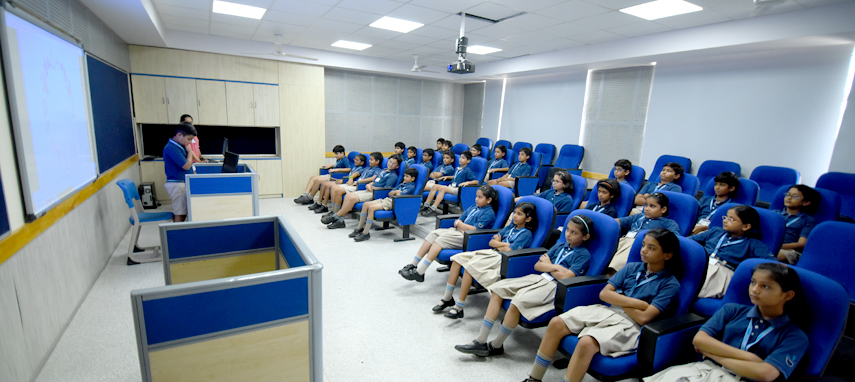
Technology at The Khaitan School is integrated thoughtfully to strengthen classroom learning while maintaining the essential role of teachers. Digital tools are used to enhance explanation, engagement, and conceptual understanding rather than replace traditional teaching methods. The focus remains on meaningful learning supported by appropriate infrastructure. Technology integration includes:
- Smart classrooms – Interactive boards and digital displays help explain complex topics visually.
- Audio-visual resources – Videos and interactive content simplify abstract concepts.
The purpose of using technology is to improve conceptual clarity, address different learning styles, and make lessons more interactive. We have also integrated digital technology that helps promote digital literacy while ensuring students remain focused, disciplined, and academically grounded.
How Is Continuous Assessment Conducted at The Khaitan School?
The Khaitan School follows assessment practices aligned with the guidelines of the Central Board of Secondary Education (CBSE), ensuring that student progress is monitored consistently throughout the academic year. Instead of relying solely on final examinations, the school adopts a structured and balanced evaluation approach that supports steady learning and reduced academic stress. Student assessment includes:
- Periodic tests – Short, structured evaluations that track understanding of recently taught concepts.
- Projects and assignments – Application-based tasks that encourage research, analysis, and creativity.
- Classroom participation – Active involvement in discussions and activities forms part of overall evaluation.
- Skill-based assessments – Activities designed to measure practical understanding and subject application.
This continuous evaluation model reduces the pressure of one-time exams and encourages consistent preparation. Regular feedback enables students to improve gradually, build confidence, and strengthen conceptual clarity over time.
How Does the Curriculum at The Khaitan School Support Holistic Development?
A meaningful curriculum shapes a child’s academic journey as well as their personality and values. At The Khaitan School, the focus goes beyond textbooks to ensure students grow intellectually, emotionally, and socially. The curriculum is thoughtfully structured to balance academic rigour with opportunities that nurture confidence, creativity, and responsibility. Real-world learning experiences, such as educational excursion to the National Craft Museum, New Delhi further strengthen practical understanding and cultural awareness. Here are our holistic development at the school is guided by a few key focus areas:
- Academic excellence supported by strong conceptual foundations.
- Critical and creative thinking, encouraging students to question, analyse, and innovate.
- Communication and collaboration skills, developed through discussions and group activities.
- Emotional and social growth, helping students build empathy and self-awareness.
- Values and discipline, fostering integrity and accountability.
Through classroom engagement, co-curricular participation, and structured academic planning, students are guided to become well-rounded individuals prepared for future academic and life challenges.
How Can Parents Decide If The Khaitan School Curriculum Is Right for Their Child?
Choosing the right curriculum requires parents to look at how well it aligns with their child’s abilities, interests, and long-term aspirations. A suitable curriculum should create a balance between academic strength and personal development while ensuring that learning remains engaging and meaningful. When evaluating suitability, parents may consider whether the school offers:
- Strong conceptual learning instead of rote memorisation.
- Engaging and progressive teaching methods that promote active participation.
- Balanced and continuous assessment to reduce exam-related stress.
- Thoughtful use of technology that enhances learning outcomes.
- Personalised attention through an optimal student–teacher ratio.
Parents are encouraged to interact with The Khaitan School admissions team, understand classroom practices, and assess how the curriculum supports their child’s overall growth before making a decision.
Conclusion
Selecting the right curriculum plays a vital role in shaping a child’s academic journey and overall development. With its CBSE-aligned framework, student-centric teaching methods, optimal class sizes, and thoughtfully integrated technology, The Khaitan School offers a balanced and future-ready learning environment. Parents are encouraged to explore the curriculum in depth, interact with educators, and choose a learning pathway that supports both academic achievement and personal growth.
Frequently Asked Questions
The Khaitan School follows the CBSE curriculum with emphasis on conceptual learning and application-based education.
Lessons use experiential learning, inquiry-based teaching, project work, and blended approaches to maintain active participation.
Smart classrooms, digital tools, AI-enabled platforms, and interactive resources help simplify complex concepts and improve engagement.
Performance is assessed through continuous evaluation methods aligned with CBSE guidelines, focusing on regular progress tracking.
